Tuesday, December 11, 2012

Polar Satellite Launch Vehicle

e Polar Satellite Launch Vehicle,usually known by its abbreviation PSLV is the first operational launch vehicle of ISRO. PSLV is capable of launching 1600 kg satellites in 620 km sun-synchronous polar orbit and 1050 kg satellite in geo-synchronous transfer orbit. In the standard configuration, it measures 44.4 m tall, with a lift off weight of 295 tonnes. PSLV has four stages using solid and liquid propulsion systems alternately. The first stage is one of the largest solid propellant boosters in the world and carries 139 tonnes of propellant. A cluster of six strap-ons attached to the first stage motor, four of which are ignited on the ground and two are air-lit.

The reliability rate of PSLV has been superb. There had been 21 continuously successful flights of PSLV, till September 2012 . With its variant configurations, PSLV has proved its multi-payload, multi-mission capability in a single launch and its geosynchronous launch capability. In the Chandrayaan-mission, another variant of PSLV with an extended version of strap-on motors, PSOM-XL, the payload haul was enhanced to 1750 kg in 620 km SSPO. PSLV has rightfully earned the status of workhorse launch vehicle of ISRO.
Typical Parameters of PSLV
 Lift-off weight     295 tonne
 Pay Load     1600 kg in to 620 km Polar Orbit,
1060 kg in to Geosynchronous Transfer Orbit (GTO)
 Height     44 metre

PSLV Milestones
    PSLV-C21 launched SPOT 6 and PROITERES on September 09, 2012 (Successful)
    PSLV-C19 launched RISAT-1 on April 26, 2012 (Successful)
    PSLV-C18 launched Megha-Tropiques, SRMSat, VesselSat-1 and Jugnu on October 12, 2011 (Successful)
    PSLV-C17 launched GSAT - 12 on July 15, 2011 (Successful)
    PSLV-C16 launched RESOURCESAT - 2, YOUTHSAT and X-SAT on April 20, 2011 (Successful)
    PSLV-C15 launched CARTOSAT-2B, ALSAT-2A, NLS 6.1 & 6.2 and STUDSAT on July 12, 2010 (Successful)
    PSLV-C14 launched Oceansat - 2 and Six Nanosatellites on September 23, 2009 (Successful)
    PSLV-C12 launched RISAT-2 and ANUSAT on April 20, 2009 (Successfully)
    PSLV-C11 launched CHANDRAYAAN-I, on October 22, 2008 (Successful)
    PSLV-C9 launched CARTOSAT-2A, IMS-1 and Eight nano-satellites on April 28, 2008 (Successful)
    PSLV-C10 launched TECSAR on January 23, 2008 (Successful)
    PSLV-C8 launched AGILE on April 23, 2007 (Successful)
    PSLV-C7 launched CARTOSAT-2, SRE-1, LAPAN-TUBSAT and PEHUENSAT-1 on January 10, 2007 (Successful)
    PSLV-C6 launched CARTOSAT-1 and HAMSAT on May 5, 2005 (Successful)
    PSLV-C5 launched RESOURCESAT-1(IRS-P6) on October 17, 2003 (Successful)
    PSLV-C4 launched KALPANA-1(METSAT) on September 12, 2002 (Successful)
    PSLV-C3 launched TES on October 22, 2001 (Successful)
    PSLV-C2 launched OCEANSAT(IRS-P4), KITSAT-3 and DLR-TUBSAT on May 26, 1999 (Successful)
    PSLV-C1 launched IRS-1D on September 29, 1997 (Successful)
    PSLV-D3 launched IRS-P3 on March 21, 1996 (Successful)
    PSLV-D2 launched IRS-P2 on October 15, 1994 (Successful)
    PSLV-D1 launched IRS-1E on September 20, 1993 (Unsuccessful)

India's major grid solar power projects

India's National Solar Mission has targeted to deploy 20 million solar lighting systems for rural areas by 2022. The country is blessed with about an estimated 5000 TWh of solar radiation. This vast resource can be tapped to meet the growing energy demand. Even if a tenth of this potential is utilised, it could solve the country’s power problems.


Solar energy has particular relevance in remote and rural areas, where around 289 million people live without access to electricity. Solar energy is the most cost-effective option for India to reduce energy poverty without having to extend national grid services to provide power for individual homes and buildings. 


A State/UT wise list of grid solar power projects commissioned so far is as follows:
S.No.
State / UT
Capacity (kWp)
1
Andhra Pradesh
100
2
Arunanchal Pradesh
25
3
Gujarat
5000
4
Karnataka
6000
5
Kerala
25
6
Madhya Pradesh
100
7
Maharashtra
1000
8
Punjab
2325
9
Rajasthan
4950
10 
Tamil Nadu
5050
11 
Uttar Pradesh
375
12 
Uttarakhand
50
13 
West Bengal
1150
14 
Andaman & Nicobar
100
15 
Delhi
2142
16 
Lakshadweep
750
17 
Puducherry
25
18 
Others
790

Total
29957


Monday, June 18, 2012

Two sisters starving for six months, rescued

Two women, who had locked themselves inside their apartment for the last six months, in Delhi's Rohini area have been rescued this morning. Police say, the two sisters Mamta (40) and Nirja Gupta (28), were undergoing some financial crisis and decided to lock themselves up. They were found immensely dehydrated and starving when an NGO found them. Mamta weighed just 15 kilos.

Thursday, June 14, 2012

11 degrees and still jobless

       
            54-year-old Ashok Kumar from Jodhpur has total of 11 educational degrees and that too in different subjects. A local vendor on Loni Railway station, Ashok Kumar also a gold medalist from Kota University in Mass Communication. But then what made him to sell sweets on a railway station?

The World's Most Expensive Places to Live 2012


           Europe’s debt crisis, slowing growth in the U.S. and worries about a hard landing in China: Even if you’ve kept your job this past year, you’ve probably had plenty to worry about. But how about the rising cost of living?


           According to a new report from human resources firm Mercer Consulting, the cost of living in North American, Asian and African cities has been rising this past year, despite the global slowdown.


           The study looked at 214 cities worldwide and used New York City as the benchmark. Mercer’s annual cost of living survey is used by multinational companies to determine compensation for their expatriate employees around the world. The rankings are based on the cost of more than 200 items in each location including housing, transportation, food, clothing and entertainment.
So, which cities are the most expensive to live in? Click ahead to find out.


1. Tokyo, Japan


     Photo: Hiroshi Higuchi/Getty ImagesTokyo is the most expensive place to live in the world for expatriates and is one of three Japanese cities to make the top 10 list this year.


            The city has risen from the number two spot last year and has been ranked either first or second for the past five years. While the cost of renting in Asia’s most expensive city has remained relatively the same, the cost of other goods like a cup of coffee, fuel and a fast-food meal has gone up over the past year. By comparison, Tokyo is about one-third more expensive than Karachi, which is the least expensive city for expats among the 214 cities surveyed by Mercer.
          As Japan’s most important economic center, Tokyo is the most desirable place for expats to live in. But the city's real estate market is expected to be hit by shrinking demand from expatriates in 2012 due to corporate cost-cutting and downsizing, according to Knight Frank.


Monthly Rent, Luxury 2 Bedroom: $4,848


Cup of Coffee: $8.29


One Gallon of Gasoline: $7.34


Daily International Newspaper: $6.38


Fast-Food Meal: $8.29


2. Luanda, Angola


      Photo: Chad Henning/Getty ImagesLuanda, the capital of Africa’s second largest oil producer, has fallen to second place this year from the number one spot it has held since 2010. An oil boom has helped Angola become the third-largest economy in sub-Saharan Africa after South Africa and Nigeria. Crude oil sales account for over 95 percent of its export revenue, and the government expects GDP growth of 12.8 percent in 2012.


        The most costly expense in Luanda is renting property, similar to number 8th ranked N’Djamena. Despite the average monthly cost of renting a luxury two-bedroom apartment falling $500 compared to last year, it still remains high at $6,500. Consumer inflation in Angola was more than 11 percent year-on-year in March.


        The country is the largest recipient of foreign direct investment in sub-Saharan Africa with inflows of nearly $10 billion in 2010, according to the United Nations Conference on Trade and Development (UNCTAD). Its main overseas investors include China, Portugal, Brazil and the U.S. and expatriates from these countries are sent to oversee local operations in Luanda.


Monthly Rent, Luxury 2 Bedroom: $6,500


Cup of Coffee: $3.90


One Gallon of Gasoline: $2.38


Daily International Newspaper: $5.46


Fast-Food Meal: $19.94*


*Replaced by club sandwich and soda in absence of any comparable fast food outlets.


3. Osaka, Japan


     Photo: Allan Baxter/Getty    ImagesOsaka, Japan’s second largest city, has moved up three spots this year from sixth in 2011 and 2010.
       Known as an important commercial center for Japan, about 1.1 million people commute into the city during the day, according to the Japanese Statistics Bureau. The city has high rental prices because of its dense population, a limited amount of accommodation and high expatriate demand. A relatively strong yen has also heightened the cost of living for expatriates. The cost of buying daily goods like a cup of coffee, fuel, an international newspaper and fast food have all gone up from last year.


       Osaka is also a key industrial hub and home to nearly 44,000 manufacturers, which creates added pressure on resources. But a strong yen and an aging labor pool have hit the once mighty industrial hub in recent decades. The city has seen a decline in manufacturing with three firms closing shop every day since the peak year of 1983.


Monthly Rent, Luxury 2 Bedroom: $3,062


Cup of Coffee: $7.02


One Gallon of Gasoline: $6.85


Daily International Newspaper: $6.38


Fast-Food Meal: $8.29


4. Moscow, Russia


    Photo: Lars Ruecker/Getty ImagesMoscow is the most expensive city in Europe for expatriates and has ranked fourth globally since 2010.


       Despite widespread concerns over corruption, red tape, pollution and growing traffic congestion, Moscow’s place as Russia’s main political and business capital makes it the top destination for expat workers. The city attracts more investment than other Russian cities and accounts for about a quarter of the country’s $1.5 trillion economy. Daily issues like power outages and safety also drive up the cost of living for foreigners.


     The rising cost of renting property is the most substantial increase in living costs for 2012, according to Mercer, with a luxury two-bedroom apartment going up by $200 compared to last year. Demand for luxury property in Moscow is also high because of growing wealth from the country’s oil and commodities boom. Moscow is home to the most billionaires in the world at 79, according to Forbes.


Monthly Rent, Luxury 2 Bedroom: $4,200


Cup of Coffee: $8.37


One Gallon of Gasoline: $3.67


Daily International Newspaper: $9.78


Fast-Food Meal: $6.70


5. Geneva, Switzerland


      Photo: Katarina Stefanovic/Getty ImagesGeneva has been ranked as the fifth most expensive place to live in the world for the past three years by Mercer. It is Switzerland’s second-largest city after Zurich. Together, the two cities represent the high cost of living in Switzerland, the only Western European country to make the top 10 list.


      Geneva is the country’s most expensive metropolitan area and like Zurich, the Swiss franc’s appreciation has raised the cost of living for expatriates. The average monthly rent for a luxury two-bedroom apartment in the city has gone up by nearly $300 from last year to around $4,800.


       Geneva is home to 20 international organizations such as the United Nations, World Trade Organization and Red Cross, making it a big draw for expats. Over 44 percent of the city’s population is made up of foreigners. The cosmopolitan hub is also home to the world’s most expensive private schools and is said to have one of the best education systems, further adding to the high cost of living for families.


Monthly Rent, Luxury 2 Bedroom: $4,818


Cup of Coffee: $6.57


One Gallon of Gasoline: $7.46


Daily International Newspaper: $4.38


Fast-Food Meal: $12.59


6. Zurich, Switzerland (Tied)


     Photo: José Fuste Raga/Getty ImagesZurich, home to a number of banking giants such as UBS and Credit Suisse, moved one spot higher this year from 7th in 2011 and 9th in 2010.


      Zurich is an attractive location for international firms looking to take advantage of Switzerland’s low tax rates. Expatriates are also drawn to Zurich’s high quality of life. The city ranks third in the world when it comes to education, tax, and security as motives for purchasers to buy luxury property, according to Knight Frank.


      While most European cities have dropped in the rankings, the strength of the local currency, the Swiss franc, has boosted the cost of living in Zurich. While Mercer ranks Zurich as the sixth most expensive city, the Economist Intelligence Unit (EIU) ranks it as number one. EIU’s survey covers 130 cities and takes into account 160 products and services.


Monthly Rent, Luxury 2 Bedroom: $3,614


Cup of Coffee: $6.02


One of Gallon Gasoline: $7.38


Daily International Newspaper: $4.38


Fast-Food Meal: $12.59


6. Singapore (Tied)


     Photo: Wsboon Images/Getty ImagesSingapore, like other Asian financial centers, has seen a big inflow of expatriates, which has pushed up the cost of housing and other living costs.


     The city has been moving up Mercer’s most expensive cities list, rising two spots this year from eighth in 2011 and 11 th in 2010. Known for its high property prices and rents compared to the rest of Southeast Asia, Singapore is also an extremely expensive place to own a car. The permit to buy a new car can cost anywhere between $46,000 to over $67,000. Prices of these 10-year permits, known as Certificate of Entitlement (COE), have jumped 40 percent since the beginning of this year.


       An average Toyota Vios subcompact costs $85,700 including the permit, up from about $60,000 at the beginning of the year, according to motoring website SGcarmart.com.


         Given the steep cost of living in Singapore, expat salaries are also correspondingly high. According to a survey by HSBC more than half of expats in Singapore earned more than $200,000 in 2011, making it the country with the highest expat salaries in Asia. Expats in Singapore need to have larger incomes than their home countries to maintain their standard of living. About 82 percent of expats surveyed said they were more likely to spend more money on accommodation, while 65 percent said they would spend more on food in 2011 compared to the global average of around 50 percent.


Monthly Rent, Luxury 2 Bedroom: $3,588


Cup of Coffee: $5.18


One Gallon of Gasoline: $6.55


Daily International Newspaper: $3.59


Fast-Food Meal: $5.66


8. N’ Djamena, Chad


       Photo: Kanbou Sia/AFP/Getty ImagesN’Djamena, the capital and economic center of the central African country of Chad, fell five spots this year from third place in 2011 and 2010.


        The key reason behind the high cost of living in N’Djamena is the difficulty in finding suitable and safe accommodations for expatriates, making the few available places extremely expensive. Companies must also take into account the personal safety of employees in the violence-mired city, further adding to costs.


          The influx of expatriates working in Chad’s oil industry has pushed up the cost of living, with a fast-food meal costing as much as $25. Chad’s oil fields have attracted a number of international energy giants such as China National Petroleum Corporation (CNPC), Exxon Mobil, Chevron and Malaysia’s state-run Petronas. Chad saw investments of more than $8 billion in 2011 by Chinese firms keen to cash in on the country’s energy industry.


Monthly Rent, Luxury 2 Bedroom: N/A


Cup of Coffee: $3.32


One Gallon of Gasoline: $6.55


Daily International Newspaper: $6.85


Fast-Food Meal: $25.18


9. Hong Kong


       Photo: Joe Chen Photography/Getty ImagesHong Kong, the only Chinese city or territory to make the top 10 list, has been ranked the ninth most expensive place to live for the past two years, falling from the eighth spot in 2010.


         One of the most substantial increases in the cost of living in Hong Kong has been in renting property. The average monthly rent for a luxury two-bedroom apartment jumped around $1,300 from $5,800 in 2011 to almost $7,100 this year. As one of the most densely populated cities in the world with limited housing supply, average house prices have skyrocketed over 93 percent between 2006 and 2011 — making Hong Kong the world’s second-hottest property market, according to real estate consultancy Knight Frank.


           Hong Kong’s reputation as a major global financial center remains a big draw for international businesses and expatriates, which in turn pushes up the cost of living. The cost of food and fuel has also gone up from last year with headline inflation jumping nearly 5 percent in April.


Monthly Rent, Luxury 2 Bedroom: $7,092


Cup of Coffee: $6.83


One Gallon of Gasoline: $8.36


Daily International Newspaper: $3.61


Fast-Food Meal: $3.54


10. Nagoya, Japan


       Photo: Jantelagen/Mark McDonald/Getty ImagesThe cost of living in Nagoya has risen rapidly in the past few years, with the city breaking into the top 10 for the first time in 2012 from 11th in 2011 and 19th in 2010.


        Nagoya is Japan’s auto manufacturing hub, and an important place of business for some of the world’s leading carmakers like Toyota, Honda, General Motors and Volkswagen.


     Expats are generally drawn to the city because of its large industrial sector. Demand for housing in the densely populated area, which is the third-largest in Japan, has driven up the cost of housing.


   Still, the cost of renting a luxury two-bedroom apartment in Nagoya is around half the cost of renting in Tokyo. But Nagoya is as expensive as Tokyo when it comes to the cost of a cup of coffee, fuel or a fast-food meal. To top it off, a surging yen has resulted in higher prices in general for expats living in Japan.


Monthly Rent, Luxury 2 Bedroom: $2,551


Cup of Coffee: $6.38


One Gallon of Gasoline: $6.70


Daily International Newspaper: $6.38


Fast-Food Meal: $8.42

Thursday, May 24, 2012

A bicycle that runs at 80 kmph


Audi unveiled an extremely emotion-inspiring sports machine, the Audi e-bike Wörthersee at Wörthersee in Carinthia, Austria. The prototype cycle combines an electric drive and muscle power. Head of Design Wolfgang Egger comments: “As a high-performance e-bike for sports and trick cycling, it features the Audi core competences of design, ultra, e-tron and connect.” The Audi e-bike Wörthersee puts in its first major appearance at this year’s Wörthersee Tour, the 31st meet for Audi, VW, Seat and Skoda fans; trial biker Julien Dupont and downhill specialist Petra Bernhard will demonstrate their stunts and streetbike skills.


1. The uncompromising dynamism of the bike prototype is fully visible at first sight. “When developing the Audi e-bike Wörthersee we drew on motor racing design principles for inspiration,” explains Hendrik Schaefers, one of the designers at Concept Design Studio Munich. “The e-bike appears incredibly precise, highly emotional and strictly functional. Indeed, the design effort focused on its function as a sports machine. All design elements are thus firmly aligned to the technical features.”


The airy frame boasts a low center of gravity and a compact overall volume. In this way, the e- bike is superbly agile at the sporty handling limits. The lithium-ion battery is incorporated into the frame and needs 2.5 hours to freuteully charge. On long trial tours, only a few simple steps are required to remove the battery and replace it with a charged one


The frame and the swinging arm that holds the back wheel are made of carbon fiber- reinforced polymer (CFRP). The same material is used for the 26” wheels, which feature an innovative “Audi ultra blade” design with broad flat spokes for an optimized transmission of pedal power. “We were able to demonstrate with the choice of materials just how closely design goes hand in hand with expertise in ultra lightweight construction,” Hendrik Schaefers comments.


Homogeneous LED light strips round out the frame and create the immediately recognizable Audi light signature. For extreme tricks and stunts the seat can be lowered to run flush with the frame itself. At the press of a button, the seat then rises up and the biker can adopt a comfortable position.


1. The cyclist can choose between a total of five cycling modes – pure muscle power, the electric motor alone, or pedaling supported by the electric motor. In the “Pure” mode, the drive power is purely the product of the cyclist’s legs, while in “Pedelec” mode you are supported by the electric motor that then makes speeds of up to 80 km/h (50 mph) possible and gives you a range of 50-70 kilometers (31-44 miles).


If you select “eGrip”, the Audi e-bike Wörthersee runs solely on the electric motor and can reach a top speed of 50 km/h (31 mph). The cyclist then controls forward momentum using a gripshift and can configure the power as desired using the computer


When performing wheelies, an electronic control system supports the rider when performing tricks and back-wheel biking. Different modes can be set using a smartphone or directly on the e-bike – either “Power Wheelie” mode, with adjustable wheelie angle for less skilled bikers or “Balanced Wheelie” mode for sporting challenges.


1. In "Balanced Wheelie" mode, the electronic control system maintains the rider’s balance, by compensating the biker’s movements forwards or backwards via the electric motor.


This means the rider can influence the bike’s speed by shifting weight: if you lean forwards the bike picks up speed, and if you lean back it slows. You select “Training” mode if you want to keep your performance constant for training purposes.


The electric motor is located at the lowest point on the frame and drives the bottom bracket shaft directly. The maximum torque delivered to the rear wheel is 250 Nm (184.39 lb-ft)..


Audi unveiled an extremely emotion-inspiring sports machine, the Audi e-bike Wörthersee at Wörthersee in Carinthia, Austria. The prototype cycle combines an electric drive and muscle power. Head of Design Wolfgang Egger comments: “As a high-performance e-bike for sports and trick cycling, it features the Audi core competences of design, ultra, e-tron and connect.” The Audi e-bike Wörthersee puts in its first major appearance at this year’s Wörthersee Tour, the 31st meet for Audi, VW, Seat and Skoda fans; trial biker Julien Dupont and downhill specialist Petra Bernhard will demonstrate their stunts and streetbike skills.less


The uncompromising dynamism of the bike prototype is fully visible at first sight. “When developing the Audi e-bike Wörthersee we drew on motor racing design principles for inspiration,” explains Hendrik Schaefers, one of the designers at Concept Design Studio Munich. “The e-bike appears incredibly precise, highly emotional and strictly functional. Indeed, the design effort focused on its function as a sports machine. All design elements are thus firmly aligned to the technical features.”less


The airy frame boasts a low center of gravity and a compact overall volume. In this way, the e- bike is superbly agile at the sporty handling limits. The lithium-ion battery is incorporated into the frame and needs 2.5 hours to freuteully charge. On long trial tours, only a few simple steps are required to remove the battery and replace it with a charged one.


The frame and the swinging arm that holds the back wheel are made of carbon fiber- reinforced polymer (CFRP). The same material is used for the 26” wheels, which feature an innovative “Audi ultra blade” design with broad flat spokes for an optimized transmission of pedal power. “We were able to demonstrate with the choice of materials just how closely design goes hand in hand with expertise in ultra lightweight construction,” Hendrik Schaefers comments.less


Homogeneous LED light strips round out the frame and create the immediately recognizable Audi light signature. For extreme tricks and stunts the seat can be lowered to run flush with the frame itself. At the press of a button, the seat then rises up and the biker can adopt a comfortable position.


Cycling modes and countless other functions can be set using the touchscreen on-bike computer. The cyclist's smartphone hooks up by WLAN to the computer – when you start cycling, for example, the immobilizer is deactivated. Video images of the trial drive or of a trick, as recorded via the in-helmet camera, are uploaded to the Internet in real time via your smartphone.


Thursday, May 17, 2012

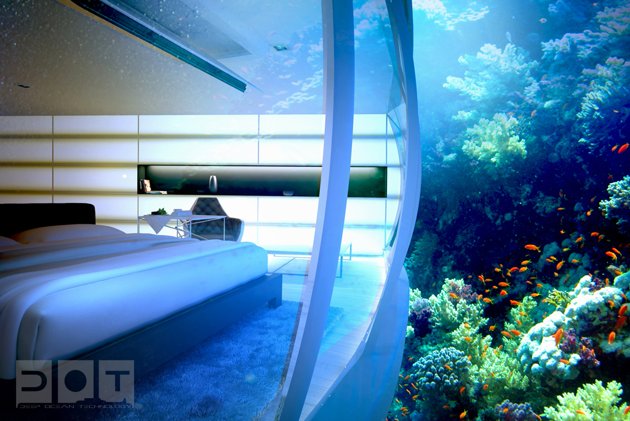
Dubai reveals plans for amazing underwater hotel


Dubai shipbuilder Drydocks World has inked a deal with Swiss-based BIG InvestConsult, on behalf of partner Deep Ocean Technology (DOT) to create Water Discus Hotel - a leisure facility with a structure that is partly above water and the rest underneath.


1)Water Discus Underwater Hotel will comprise two discs - an underwater and above-water one. This combination will allow guests to admire the depths of the ocean while making the most of the warm climate.


2) The two parts of the structure are connected by three solid legs and a vertical shaft containing a lift and stairway. The size of each disc has been adjusted to local conditions.


3)The Water Discus complex was designed to ensure safety at all times, even in the most adverse weather conditions. The structure sits up on three sturdy legs fixed to the seabed, and the upper disc is suspended above the water surface. These two technical solutions will ensure that Water Discus remains safe even in the event of a fairly high tsunami, which can normally flood the nearest coastal areas.


4)The complex is surrounded by a beautifully vibrant coral reef. This unique location will allow visitors to enjoy the tropical weather and the colourful underwater world. The disc, located up to 10 metres beneath the surface of the sea, is composed of 21 hotel rooms adjacent to the underwater dive centre and a bar. Each room is integrated with the underwater world as closely as possible, offering a surprisingly direct, yet safe contact with the local flora and fauna.


5)The disc and its adjacent satellites located 5 - 7 metres above the water surface comprise a restaurant, a spa and a special recreation area.


6)A multifunctional lobby built inside an enormous swimming pool shows the centre of the disc. The area around the underwater part of the complex and diving activities may be watched as they happen on the screens hanging on the lobby walls. This part of the complex is connected to the satellites with glass-walled tunnels cutting through a training pool for divers.


7)Dubai shipbuilder Drydocks World has inked a deal with Swiss-based BIG InvestConsult, on behalf of partner Deep Ocean Technology DOT) for creation of the hotel.


8)The financial details of the deal, exact location and date of commencement of construction are still not known


9)Dubai, has never failed to surprise. From its modest beginnings as a sleepy fishing hamlet just a few decades back, the ‘city of gold’ has taken giant strides, establishing itself as a major financial, trading and tourist centre. And yes, a destination to witness some of the world’s stunning architectural achievements.


10)Burj Al Arab is a luxury hotel located in Dubai, United Arab Emirates. At 321 m (1,053 ft), it is the fourth tallest hotel in the world. Burj Al Arab stands on an artificial island 280 m (920 ft) out from Jumeirah beach, and is connected to the mainland by a private curving bridge. The shape of the structure is designed to mimic the sail of a ship.


11)Palm Jumeirah, Palm Jebel Ali and Palm Deira) which extend into the Persian Gulf, increasing Dubai’s shoreline by a total of 520 kilometres (320 mi). The Palm Jumeirah is in the shape of a palm tree. It consists of a trunk, a crown with 16 fronds, and a surrounding crescent island. (Image credit: Nakheel)


12)The World or World Islands is an artificial archipelago of various small islands constructed in the rough shape of a world map, located 4.0 kilometres (2.5 mi) off the coast of Dubai. The World islands are composed mainly of sand dredged from Dubai's shallow coastal waters, and are one of several artificial island developments in Dubai.


13) A closer view of The World is seen from the air. The World consists of over 300 man made islands strategically positioned to form the shape of the world map


14)Almost two years of planning, research development and design went in to the construction


15)Though this is not a creation based inside or under water, no summary of Dubai's architectural feats can be completed without mentioning this one.
Standing at 829.84 m (2723 ft), the Burj Khalifa is currently the tallest building in the world.